
Credit: PUCP
A team from the Pontificia Universidad Católica del Perú (PUCP) set out to understand how conservation policy can respond to the changing realities of the families whose livelihoods depend on keeping the Amazon forest standing. In this interview with Principal Investigator Mario R. Cepeda Cáceres, we learned more about this groundbreaking work.
Please tell us about the work you undertook with support from Tinker. What did you set out to achieve?
Our team at the Pontificia Universidad Católica del Perú (PUCP) worked with Brazil nut-collecting families in Madre de Dios, in the Peruvian Amazon. We sought out to assess the long-term sustainability of this forest-based livelihood: how can it remain viable across generations as younger family members pursue a more diverse range of educational and livelihood pathways, some of which may offer more immediate economic returns without necessarily providing greater stability or sustainability.
Why focus on Brazil nuts (Bertholletia excelsa)? Why is this such a significant value chain for forest communities?
Brazil nuts are one of the most important non-timber forest products in the Peruvian Amazon and offer a particularly significant example of how forest-based livelihoods can contribute to conservation: their collection generates income while depending on the maintenance of healthy standing forest. Yet sustaining this model is increasingly challenging. Brazil nut collection remains physically demanding, largely manual, and only minimally mechanized. Incomes are highly exposed to seasonality, climatic variability, and fluctuating market prices.
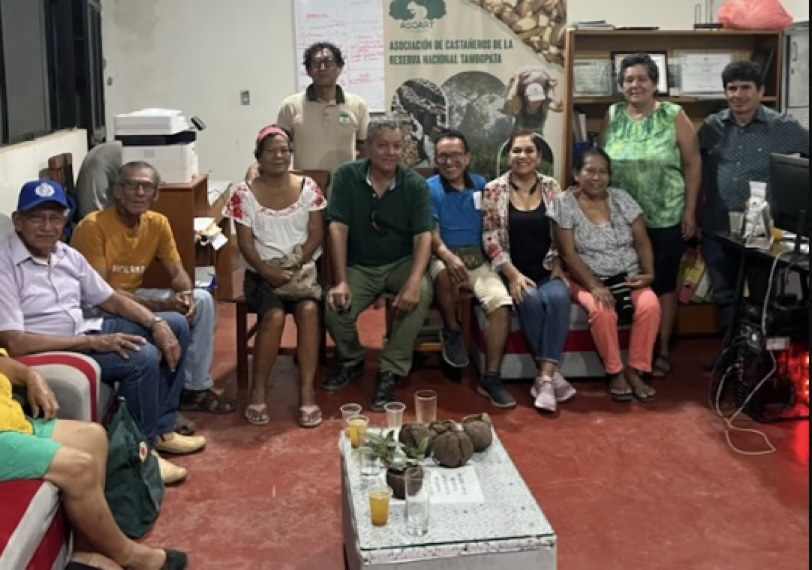
We began our work with the Asociación de Castañeros de la Reserva Nacional Tambopata (ASCART), whose members have decades of experience collecting and managing Brazil nuts within the Tambopata National Reserve. Through an ethnographic diagnosis, we examined how knowledge and practices were transmitted within families, how and why younger generations were engaging with the activity differently from their parents, and how economic conditions, gender relations, and conservation regulations were shaping its future. As the project developed, our collaboration expanded and deepened through a partnership with the Servicio Nacional de Áreas Naturales Protegidas por el Estado (SERNANP), Peru’s national protected-areas authority. This allowed us to work beyond the initial group associated with ASCART, engage a broader range of Brazil nut collectors, and connect the findings from our research with training activities and protected-area management processes.
Our goal was therefore not simply to preserve or “transfer” traditional knowledge, but to understand what social, economic, and institutional conditions are needed for younger generations to see a viable future in Brazil nut collection. We also wanted to understand how conservation policy can respond to the changing realities of the families whose livelihoods depend on keeping the Amazon forest standing.
What do you consider the most important outcomes and learnings from the project?
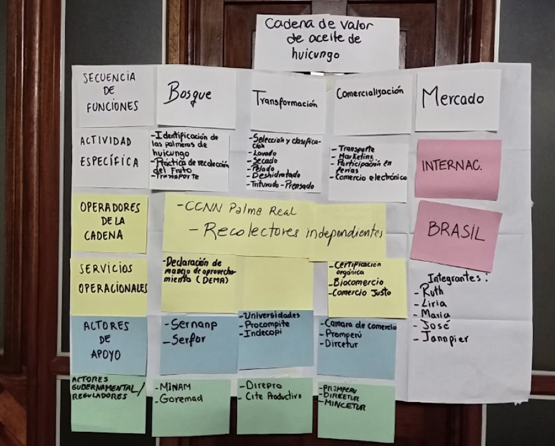
One of the most important outcomes was the project’s ability to connect research with concrete processes of protected-area governance. Our collaboration with SERNANP allowed findings from the ethnographic work to inform discussions around the Plan Maestro de la Reserva Nacional Tambopata (Master Plan for the Tambopata National Reserve), bringing the concerns of Brazil nut collecting families—particularly around generational renewal and the conditions under which the activity remains viable—into a formal conservation-planning process. Just as importantly, the project helped build a stronger relationship between collectors, researchers, and protected-area managers, creating a space in which ethnographic evidence and local experience could inform institutional decision-making. The training activities we later developed around bio-business, adding value, and commercialization were grounded in that participatory diagnosis rather than imposed from an external perspective. They responded to needs and possibilities identified through fieldwork with collectors themselves and became a way of exploring how Brazil nut collection might become more economically viable and attractive to a new generation.
How did your understanding of the “problem” you were trying to solve evolve over time?
Our work with communities reshaped how we understood the problem itself. Generational renewal cannot be explained simply as a matter of young people “losing” traditional knowledge or becoming uninterested in the forest. Knowledge continues to be transmitted within families, but younger people make decisions in a very different economic and social environment from that of their parents. Higher levels of education, physically demanding and minimally mechanized work, unstable incomes, climatic variability, market fluctuations, and the attraction of other—sometimes more lucrative but also more precarious or environmentally harmful—activities all shape their choices. This led us to see that the future of Brazil nut collection, and of the conservation model associated with it, depends not only on transmitting knowledge but on creating the social, economic, and institutional conditions in which that knowledge can continue to be put into practice. More broadly, the Brazil nut case speaks to a wider challenge across the Amazon: conservation strategies based on the sustainable use of non-timber forest products can only endure if the livelihoods on which they depend can also adapt and remain viable as social, economic, and environmental conditions change.
You encountered some notable operational challenges during the life of the project. How did you adapt?
The project began in the context of a profound political crisis in Peru starting in late 2022, which led to an extended period of protests, states of emergency, and restrictions on movement within Peru. For a project requiring sustained travel to and within Madre de Dios, these conditions initially made fieldwork extremely difficult and forced us to postpone much of what had been planned for the early stages. But the consequences went far beyond our own ability to travel. The blockades and disruption of transport routes also affected the wellbeing of Brazil nut collecting families, at times isolating Puerto Maldonado and disrupting the movement of workers and goods, as well as production, commercialization, and export chains. This generated significant economic pressures on an activity already characterized by seasonal and unstable incomes, and some of those effects continued to be felt during the subsequent years in which the project was implemented. We therefore had to understand the political crisis not simply as an external logistical obstacle, but as part of the changing social and economic context in which collectors themselves were making decisions about their livelihoods.
We also encountered slower institutional and administrative timelines that often accompany collaboration across a university, a public protected-areas agency, and local organizations. Rather than trying to preserve the original timetable at all costs, we reorganized the sequence of activities: while mobility was restricted, we concentrated on preparatory work, documentary review, coordination, and research design, and resumed intensive fieldwork once conditions allowed. Tinker’s flexibility, understanding, and support were crucial to making that adaptation possible. The Foundation remained closely engaged with the project, showed sustained interest in how it was evolving, and gave us the flexibility to extend the timeline and adjust activities without compromising its central objectives. As the project moved into its training and institutional phases, we similarly prioritized depth over scale and grounded the training in needs identified through the ethnographic diagnosis.
At the same time, an unexpected opportunity emerged from the delays: the later stages of the project coincided with SERNANP’s participatory process for developing the new Plan Maestro de la Reserva Nacional Tambopata. This allowed us to connect evidence built progressively through fieldwork with an ongoing policy process.
One of the practical lessons for us was therefore that adaptability does not mean lowering ambitions: it means protecting the project’s core objectives while being willing to change the sequence, timing, and format of activities, and recognizing when difficult circumstances may also open unforeseen opportunities for research to inform conservation practice.
What do you see as the most relevant broader learnings from this work? What are takeaways for others working to advance conservation in partnership with local communities?
One of the broader lessons from this work is that conservation partnerships need to move beyond consulting local communities about policies or interventions designed elsewhere. Local knowledge and experience should help shape the questions being asked, the activities that follow, and, where possible, the institutional instruments through which conservation is governed. In our case, ethnographic work with Brazil nut collectors did not simply document their perspectives: it helped identify priorities for training and created a basis for bringing those concerns into dialogue with SERNANP and the management of the Tambopata National Reserve. This requires time, trust, and institutional flexibility, but it can produce forms of conservation that are better grounded in the realities of the people who live from and care for the forest.
A second lesson is that conservation based on the sustainable use of forest resources cannot be separated from the economic and social viability of the livelihoods that sustain it. Non-timber forest products such as Brazil nuts can create a powerful alignment between income generation and keeping forests standing, but that alignment should not be taken for granted. It depends on changing labor conditions, markets, climate, regulation, generational aspirations, and the availability of alternative livelihoods. For others working in conservation, this means asking not only how communities can adapt to conservation objectives, but also how conservation institutions and policies need to adapt to changing community realities.
We have also begun to share these findings through presentations at academic and conservation conferences, and we are currently completing a PUCP working paper that brings together the project’s main findings. At the same time, the project has opened a new research agenda around questions that require further ecological investigation, including the health and role of pollinators in sustaining Brazil nut production. In that sense, the work has generated not only findings and policy lessons, but also a set of new questions about how social, economic, and ecological change interact in shaping the future of conservation across the Amazon.
Credit: Alvaro M. Castro Mayo
Caption: Meeting with the Asociación de Castañeros de la Reserva Nacional Tambopata (ASCART), whose members have decades of experience collecting and managing Brazil nuts within the Tambopata National Reserve.
